Volume : 2 | Issue : 1
Research
Evaluation of palm trees hybrids (inter specific backcross BC1) E. oleifera x E. guineensis for their sensitivity to the attacks of the leaf miner
Magloire Oteyami,1 Elisabeth T. Zannou,1 and Alassane Coffi2
1Faculty of Agronomic Sciences, University of Abomey-Calavi, Benin
2National Institute of Agricultural Research, Center for Agricultural Research Perennial Plant of Pobe (CRAPP-Pobe), Benin
Received: September 10, 2018 | Published: February 25, 2019
Abstract
The leaf miner Coelaenomenodera lameensis is the most serious pest of oil palm in West Africa. A survey on the assessment of the oil palm backcross for their sensitivity to the attacks of this beetle is achieved in Benin. An experimental meadow test for infestation of the palm leaves has been carried out through this survey. For achieving this, and by using muffs, adults of Coelaenomenodera lameensis were released on leaves at the 9th, 17th and 25th position on five trees. According to this meadow test results, thirty (30) backcross population were infested with the same procedure using only the seventeenth leaf. Our results showed that the rate of survival of this pest is variable within backcross population. So on the whole of the 30 tested backcross, three (03) levels of sensitivity appeared within the population. The analysis of variance revealed a meaningful difference (p <0,05) between the survival rates during the pest development or passage from the egg to the adult stage according to the whole of the backcross tested. The individuals from the crosses (MANGENOT x La Me) x Deli, (SAN ALBERTO x Yangambi) xYangambi, (PANAMA xLa Me) xDeli and (MONTERIA x La Me) x Deli are tolerant.
Keywords:Coelaenomenodera lameensis, backcross, oil palm, Benin
Introduction
The industrial production of palm oil relies almost exclusively on the African oil palm (Elaeis guineensis). In West Africa, and more particularly in Benin, this plant material is vulnerable to the devastation of insects belonging mainly to the orders of Coleoptera and Lepidoptera.1 Among these insects is the oil palm leaf miner : Coelaenomenodera lameensis (Coleoptera : Chrysomelidae - Hispinae), currently considered the main pest of the oil palm.2 In fact, the larvae of this beetle cause extremely important damage such as defoliation and rapid drying of the leaflets. This damage leads to a yield reduction ranging from 30 to 50% for 2 to 3 consecutive years.3 In order to control and reduce the population of the pest to an economically acceptable level, control methods are applied by the producers. But these means of struggle that currently exist are not satisfactory. Indeed in the palm groves to control the population Coelaenomenodera lameensis, only the chemical treatments have proved effective. As a result, thermo-nebulization is the most widely used chemical treatment method.4–6 However, it has disadvantages : it is a method that is only applicable to non-rugged areas of 500 hectares7 and is not suitable for small-scale palm plantations. Added to this is the probable deterioration of the active ingredient at 60°C8 resistance problems of the pest and the destruction of natural enemies associated with this pest because of its repeated use.9 It should also be noted the difficulty of applying this pesticide and the high cost of treatment. These different constraints prompted researchers to resort to the cultivation of the second species of oil palm (Elaeis oleifera or American palm), whose oil yield is low. Indeed, this species has characteristics that make it very interesting for genetic improvement, including slow trunk growth and a mesocarp with a high oil content of unsaturated fatty acids and in particular its resistance to this leaf miner.
Indeed, previous observations have shown that the species E. oleifera is much less attacked than E. guineensis.10 Since these two (02) species are inter-compatible,11 it may be possible to transfer E. oleifera resistance to E. guineensis. In such a context, the production of this type of material is today the most interesting, effective and adapted to the socio-economic conditions of small local plantations, as part of the fight against the leaf miner. Taking advantage therefore of the inter-fertility of these two species of the genus Elaeis, and the fertility of their descendants, the Center for Agricultural Research Perennial Plant of Pobe (CRA-PP) and CIRAD like other research stations have been conducting a "backcross program" for the past ten years, aimed at transferring the characteristics of interest of E. oleifera to the African palm tree, in particular leafminer resistance. About 30 interesting trees (BC1) have already been identified for this program and must now be evaluated for leafminer resistance. The trees selected for this purpose will serve as a starting point for the next generation of backcross (BC2).
The main objective of this study is to identify and evaluate 30 backcross planted in 1998 at the Pobè CRAPP station for their susceptibility to leafminer Coelaenomenodera lameensis attacks by the conventional screening method. Specifically, it was first to study the effect of the rank or position of the leaf on the degree of infestation and the development of the pest and then to evaluate the survival rate different stages of development (eggs, larvae, nymphs and adults) of C. lameensis on a wide range of 30 Backcross materials.
Study Area
Experiments were conducted at Center for Agricultural Research Perennial Plant of Pobe (CRAPP-Pobe) in Benin.
Climate
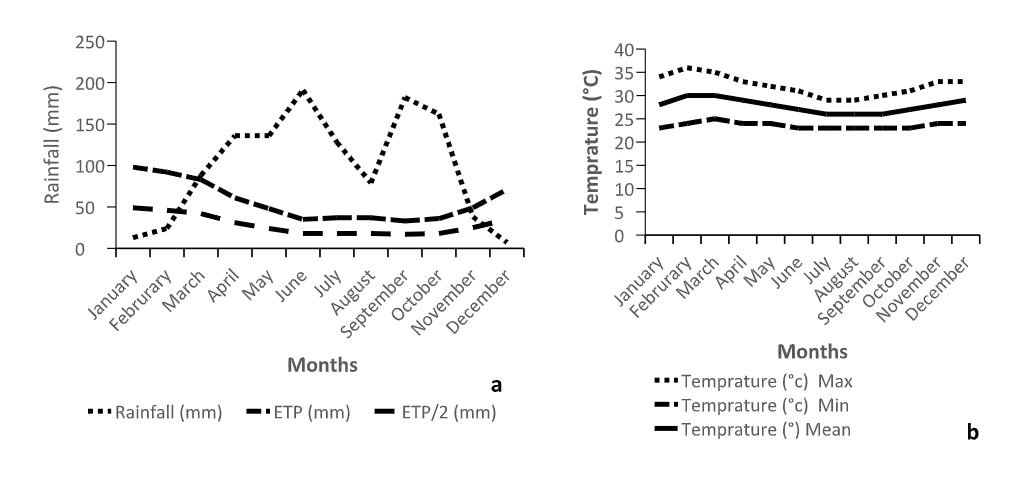
The climate of the center of Pobe (CRAPPA - Pobe) is representative of that of southern Benin whose average monthly rainfall varies between 20 mm and 200 mm (Figure 1a) with a bimodal distribution. Over most of the year, the rainfall is greater than or equal to half of the ETP (Figure 1a). This should correspond to the active period of vegetation.12
|
Figure 1 Evolution of the climatic conditions of the study area between 2000 and 2011 (a) rainfall and (b) temperature |
Mean annual temperatures recorded between 2000 and 2011 vary between 25.8°C and 30.0°C. The maxima vary between 28.9°C and 35.5°C while the minimums are between 22.6°C and 24.9°C for the same period (Figure 1b). The hottest months are the months of February and March and the coolest month is August (Figure 1b). The average monthly solar radiation varies between 12.04 and 19.53 MJ. m-2. J-1 with an annual average of 14.91 MJ. m-2. J-1. The site of this center is included in the subequatorial or Beninian climate zone and is characterized by :
- A large rainy season (mid-March to mid-July) ;
- A long dry season (mid-November to mid-March) ;
- A small dry season (mid-July to mid-September) ;
- A small rainy season (mid-September to mid-November).
Soil
The soil of the site is classified as low desaturated ferralitic soils, red, deep, sandy clay, formed on sandy-clay sediments of Continental Terminal ; they are sometimes impoverished on sandy clay sediment. From the morphological point of view, the site occupies a homogeneous set of soil. The soil has a low clay content. As for the silt content, it varies between 4 and 10%.13
Materials and methods
Plant material
The plant material consists of thirty (30) backcross (Table 1), installed on parcel 270 since 1998 (test GP30) and five (05) E. guineensis grown on plot 553.The backcross (BC1) trees are derived from crosses between guineensis (of LaMé, Déli and Yangambi origin) and interspecific hybrids (of origin LaMé, Yangambi, NIFOR). Guineensis used for crossbreeding belong to different varieties (Dura, Tenera, Pisifera), while interspecific hybrids are Tenera. As for the oleifera, they are of origin either of Central America / Colombia, or of Brazil. These trees allowed us to evaluate the survival rate of the developmental stages of Coelaenomenodera lameensis while the five (05) feet of E. guineensis (commercial varieties) of plot 553, all planted in 1994, allowed us to study the effect of the rank or position of the leaf on the degree of infestation and on the development of the pest.
|
Sources |
DDL Num. |
DDL Res. |
F-Valeur |
P-Valeur |
|---|---|---|---|---|
|
Stages |
4 |
136 |
2.06 |
0.0890ns |
|
Serie (stage) |
12 |
136 |
1.78 |
0.0567* |
|
Individual (stage) |
81 |
136 |
0.55 |
0.9982ns |
Table 1 Variance analysis of fixed factors
*= significant difference (p < 0.05) ; ns= not significant difference (p > 0.05)Biological material
The biological material consists of Coelaenomenodera lameensis grown in the laboratory. Indeed, the insects that were the subject of the field tests were collected in the form of nymphs which from leaflets attacked palms of the station of Pobe. After extracting the nymphs from their gallery, they were isolated in petri dishes on a wet absorbent paper for 17 days, without being fed, to facilitate the metamorphosis to perfect imago. This is a technique that gives the advantage of having adult insects of known age and sex at emergence for subsequent experiments such as setting sleeves.
Evaluation of the survival rate of Coelaenomenodera lameensis development stages in the thirty (30) Backcross
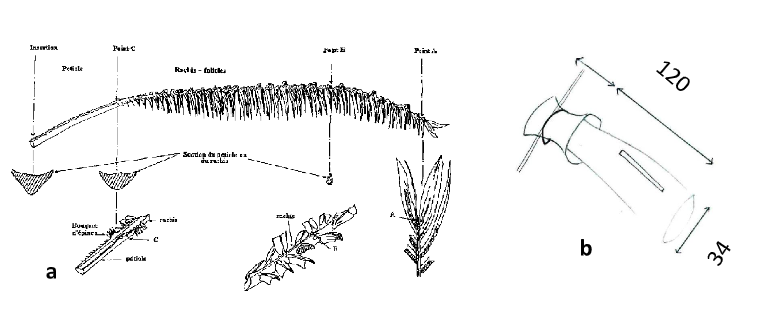
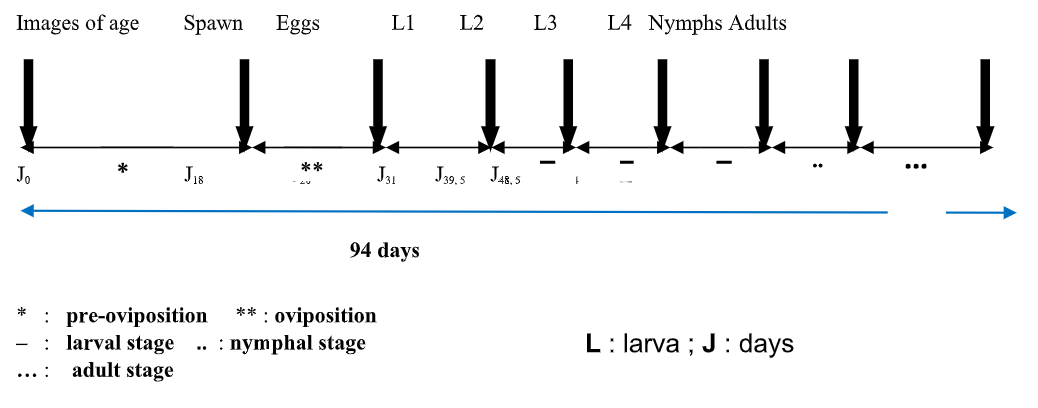
The sleeves are formed of a muslin tube 34 cm in diameter and 120 cm long (Figure 2). The existence of two arches disposed at each end of the sleeves has maintained the structure of the sleeves. An opening for the introduction of insects has been provided for several centimeters and closed with an adhesive tape or scratch. The cuffs (pre-labeled) were attached to the spine and the seal was provided by a mass of cotton avoiding the accidental introduction of predators (ants) and parasitoids C. lameensis. After five weeks, a second set of sleeves was placed on a new leaf (F17) at point B (where the spine gutter disappears to be replaced by a sharp edge), around five (05) leaflets, on the thirty (30) backcross for four series in total. Thus on the thirty (30) backcross, the device described below has made it possible to evaluate the survival rate of the different stages of C. lameensis development. From emerged adult insects reared in the laboratory, thirty (30) virgin females (under 18 days) and ten (10) males were introduced into each of the thirty (30) sleeves per set of poses. In fact, 18 days represent the age of spawning in adults of the species.14 The released insects were maintained in the sleeves for eleven (11) weeks until the adult deaths to ensure that all L1L2 transitions to L3L4 were performed (Figure 3).
|
Figure 2 Description of sleeve and F17leaf (a) point B of F17 leaf and (b) muslin |
|
Figure 3 Diagram of evolution of the different stages of Coelaenomenodera lameensis development |
Eleven weeks after the introduction of Coelaenomenodera lameensis imagos, the sleeves are unhooked and the leaflets are removed and taken back to the laboratory, taking care to keep the identification tag bearing the number of the tree, the number of the series and the date of introduction of C. lameensis imagos. Note that the eleven (11) weeks represent the minimum duration after which an egg of Coelaenomenodera lameensis develops to give an imago. For each set of sleeves, and for each backcross, all dead and live stages of Coelaenomenodera lameensis are identified and counted for the five (05) leaflets. Observations of developmental stages were made on the underside of the palms using a binocular microscope (Zeiss stemi B24). In addition, during the skinning, insects of the same stage are collected (dead and alive together) and placed in the same Petri dish and arranged as follows : 1 box for eggs, 1 box for L1L2, 1 box for the L3L4, 1 box for the nymphs, 1 box for the imagos. At the end of the count, the total number of individuals from the different stages of development collected over the thirty (30) backcrosses was calculated. (First count). The total number of individuals from each stage contained in each petri dish was also counted (eggs, L1L2, L3L4, nymphs, imagos) (Second count). Based on the total number of individuals of different stages counted on each backcross after the artificial infestation and the number of eggs initially laid on the leaflets in the sleeves, various parameters are calculated namely :
The success or survival rate by stage of development of Coelaenomenodera lameensis:
Where:
Ts (%) : survival rate
Xi : number of larvae (L3L4) / nymphs / emerged adults
Ni : total number of eggs
Hatching rate:
Where :
Te (%) : Hatching rate
X : number of hatched eggs
N : number of eggs laid
Effect of row or position of leaf on degree of infestation and development of the pest
The experimental design used for this study is a total randomization with two factors (rank and developmental stages of Coelaenomenodera lameensis) and with five replicates. This experiment consisted in placing sleeves on the sheet of row 9 (F9), the rank sheet 17 (F17) and the row sheet 25 (F25) of the oil palm (E. guineensis). For each row of leaf considered, the sleeve was placed on five different trees. Sleeve placement was performed on the five (05) feet of E. guineensis oil palm ; a total of fifteen (15) trees. Eleven weeks after the introduction of Coelaenomenodera lameensis imagos, the sleeves are removed and the leaflets are returned to the laboratory for observation of the developmental stages according to the method described above. The number of larvae (dead and alive), eggs (dead and alive), nymphs (dead and alive) and adults (dead and alive) were estimated according to the following formula :
Where :
N : total numbers of eggs / larvae / nymphs / adults (dead and alive)
ni : number of eggs / larvae / nymphs / adults (dead and alive) per leaflets
Data analysis
The data was entered with the Excel spreadsheet version 2007. The statistical analysis of the data was performed with the SAS program (Statistical Analysis System) (SAS Institute 2003). The overall analysis of the variables studied was carried out using the following statistical analysis methods :
- One-dimensional descriptive analysis of the variables used as descriptors of the different groupings. Indeed, a calculation of the average of the mortality rates, hatching rates, rates of passage from one stage to another, the average number of individuals laid in the sleeves was carried out in order to analyze the performances of the different backcross related to the resistance. This allowed to make tables in order to present the results in the simplest, most expressive way to better interpret them.
- The statistical analysis of variance (ANOVA) and Tukey homogeneity were used to compare the averages of the variables used. The total number of insects underwent Logarithmic transformation (Log) to stabilize the variance. The method of estimating rates of passage was made according to the method called "Continuation ratio model" and allows to take into account all the successive passages that we know that a given individual has suffered from the stage where we observes.
Results
Effect of the position of the leaf of the palm tree Elaeis guineensis on the degree of attack by the pest Coelaenomenodera lameensis
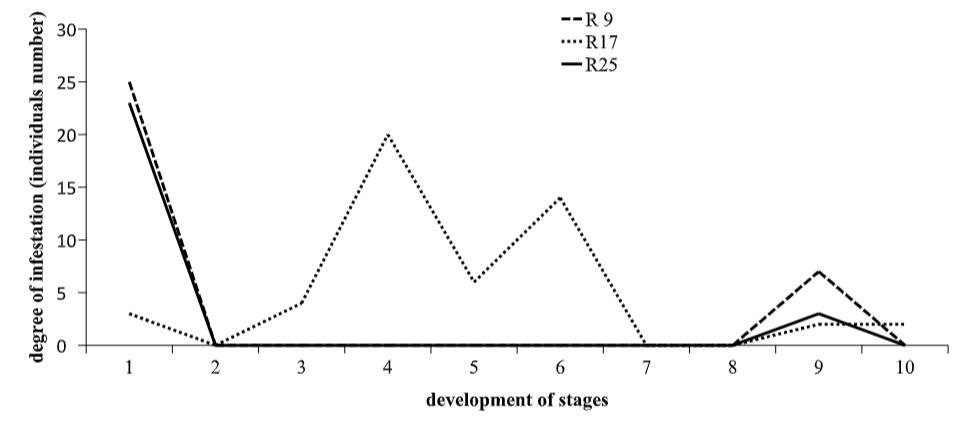
Figure 4 shows the results obtained with regard to the effect of the row of the leaf on the degree of infestation of the plant and on the development of the pest. We note that eggs, larval stages (L1L2 and L3L4) and adults of Coelaenomenodera lameensis were observed at the level of the row 17 leaf compared to the leaves of row 9 and 25 where only eggs and dead adults are only noted. Indeed, on the sheet of row 17 we recorded on average 20 and 14 living individuals respectively for the stages L1L2 and L3L4 (Figure 4). While at the level of the leaves of rows 9 and 25, we did not notice any individual (larvae). On the other hand on these leaves we counted 25 and 23 dead eggs respectively at the level of the sheet of row 9 and 25.
|
Figure 4 Effect of the position of palm leaves on the larval development of Coelaenomenodera lameensis |
The statistical analysis of these results by analysis of variance first shows that there is no significant difference between the rows (p> 0.05) for the eggs, nymphs and adults at the threshold of 5 %, then a significant difference between rows (p <0.05) for L1L2, L3L4 at the 5% threshold. This confirms the hypothesis that the position of the leaf on the plant influences the development of the pest especially for larval stages.
The generalized desiccation observed on the leaflets results from the growth and the fusion of the larval galleries within which these different larval stages take place.
Given these results we deduce that the larval stage causes a lot of damage compared to other stages. These results confirm those of Philippe15 according to which the larvae cause a lot of damage on the fins. In addition, it appears from these results that the sheet of row17 offers many more favorable conditions for the development of Coelaenomenodera lameensis compared to other leaves in positions 9 and 25. The leaves of rows 9 and 25 do not seem to favor the development larvae of Coelaenomenodera lameensis contrary to what is observed on the rank 17 leaf on which almost all larval stages are observed. Leaves in position 17 do not seem to favor the development of the nymphs of the pest.
Survival rates of the different stages of development of Coelaenomenodera lameensis on the backcross tested
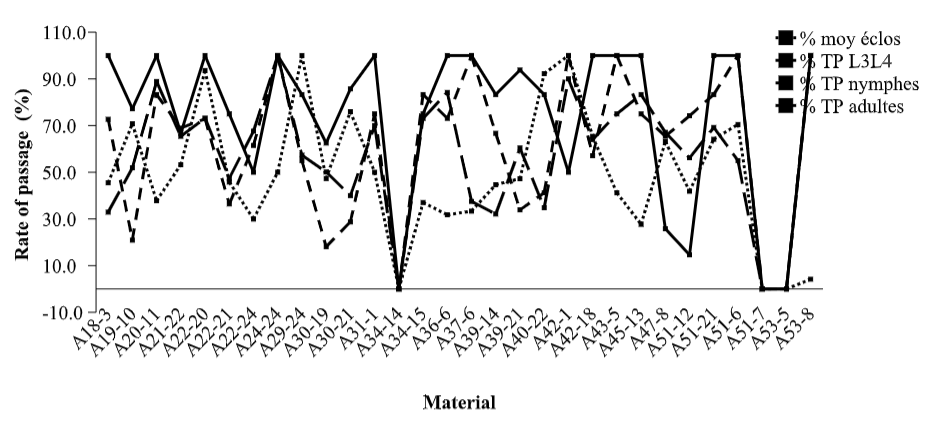
Figure 5 shows the results obtained by following the development steps of Coelaenomenodera lameensis on the backcross. From eggs monitored, the larval passage rate from L1L2 to L3L4 is 19.61% on average at seven backcrosses (A18-3, A34-14, A37-6, A39-14, A40-22, A51-7 and A53-5). This rate is 33.33% for the backcross A53-8, A24-24 and A42-1, and 65.41% for the other backcrosses. With regard to the passage from the L3L4 stage to the nymphal stage, at the level of these same backcross, there is a transition rate of 17.25% over eight backcross (A19-10, A22-21, A30-19, A30-21). A34-14, A39-21, A51-7 and A53-5) on average ; 16.66% at six backcrosses (A53-8, A51-6, A37-6, A24-24, A43-5, A42-1) ; and 69.29% on the other backcrosses.
|
Figure 5 Evolution of the passage rate from L1L2 stage to L3L4 stage and from L3L4 stage to nymphal stage and adult stage nymphal stage of C. lameensis according to backcross |
With to survival rate from nymphal stage to adult stage, we averaged 10.1% for four backcross (A47-8, A51-12, A51-7, A53-5) ; 7.69% for thirteen backcrosses (A53-8, A51-6, A51-21, A43-5, A42-18, A37-6, A36-6, A31-1, A24-24, A22-20, A18- 3, A20-11 and A45-13) and 73.81% on the other backcrosses.
This observation shows a significant difference (p <0.05) between the rates of passage of the number of eggs laid at the other stages of development following the series (Table 1). Similarly, the egg hatch rate test reveals, that there is a very highly significant difference (p <0.05) between backcrosses (Table 2). As for the rate of passage of the number of eggs laid in stage L3L4, nymph stage and adult stage within the backcross, no statistical difference was observed.
Backcross |
Average hatching rate of eggs (%) |
|---|---|
A22-20 |
97.453 a |
A40-22 |
95.948 a |
A19-10 |
86.945 ab |
A30-21 |
79.713 abc |
A51-6 |
77.860 abc |
A47-8 |
67.531 abc |
A51-21 |
63.546 abc |
A42-18 |
60.820 abc |
A39-21 |
56.510 abc |
A21-22 |
46.397 abc |
A30-19 |
43.359 abc |
A22-21 |
42.010 abc |
A43-5 |
40.492 abc |
A18-3 |
39.150 abc |
A51-12 |
39.011 abc |
A37-6 |
38.950 abc |
A36-6 |
31.740 abc |
A39-14 |
28.342 abc |
A22-24 |
26.931 abc |
A34-15 |
22.077 bc |
A31-1 |
20.053 bc |
A45-13 |
16.598 bc |
A53-8 |
10.660 bc |
A24-24 |
10.584 bc |
A20-11 |
9.785 c |
Table 2 Average hatching rate of eggs between backcross
Discussion
Effect of leaf position on degree of attack and development of Coelaenomenodera lameensis larvae
The test of the effect of the rank or position of the leaf on the development of Coelaenomenodera lameensis induced a difference in the behavior of the pest with respect to oil palm infestation. Indeed, the abiotic factors in this case sunlight could prove to be conditions determining the degree of infestation observed at the ranks of the oil palm leaves. Thus, the row 9 palm leaf being more exposed to light from the sun's rays offered favorable conditions for pest infestation as demonstrated by the large number of eggs counted on this leaf. However, the evolution of these eggs into larvae of different stages has been very unfavorable at the level of this sheet of row 9. Similarly shading seems to be another handicap to this infestation, since the same observations as previously are observed at Indeed, light plays a role in the inhibition of the development stages of Coelaenomenodera lameensis because, according to Mariau and Morin (1974),16 the larvae sheltered from their gallery are less sensitive to variations of temperature as eggs. In addition the young galleries can dry out with high temperatures and this mainly on the high leaves of the crown. In addition, the inexistence of developmental stages in lower row leaves (25) may be due to the age of said leaves, their proximity to the soil and their aging. The old age of these leaves could constitute unfavorable conditions for the development of the various stages of the insect because of its low level of palatability because the host plant is a food source and plays a determining role in the dynamics of populations with its components nutritious (proteins, amino acids, carbohydrates, lipids, vitamins, minerals, water, etc.) and its non-nutritional components: allelochemical compounds, phenols, polyphenols, monoterpenes, glucosinolates, alkaloids, etc.17 The leaves located in position 17, seem to offer adequate conditions for the outbreak of the pest. The majority of the eggs laid on row 17 leaves had a favorable development during which almost all stages were observed. According to Mariau and Lecoustre,18 the insect prefers favorable conditions (average temperature, average hygrometry) for its development. This may justify the preference of the sheet of rank 17 for the other leaves of rows 9 and 25.
Survival rate of different stages of development of Coelaenomenodera lameensis on Backcross
This parameter makes it possible to follow the different stages of development of this pest after hatching of the eggs. During the follow-up we recorded low survival rate from L1L2 to L3L4 at backcross level. This high mortality of L1L2 larvae would depend either on the presence of one or more inhibiting substances in the leaflets, or on the heavy rainfall recorded during the experimental period which would have destroyed the larval galleries.16 This high larval mortality at the L1L2 stage may also be related to the size of the backcross. Indeed backcross tested are large palms. As we noticed during the observations on the position of the leaves on the palm tree of infestation, we could say here that the higher the palm, the more it is exposed to the solar rays which are unfavorable to the development young larvae. With L3L4 stage-nymphal low rates recorded at some backcross compared to other backcrosses with higher passage rates, significant L3L4 larval mortality could also be correlated with plant size. In both cases, an intra-larval competition due to the mass effect would explain this high mortality. The rate of passage of nymphs in the adult stage has been very variable within the backcross. This variability in the development of the insect, passing from the nymphal stage to the adult stage, would be explained by the genetic origin of the material used. Indeed the insect during its development stops feeding at the nymph stage. Its development therefore depends essentially from this stage of the substrate on which it develops. That is, the physical quality of the plant material. In addition, the backcrosses with the lowest rates of passage from the pupal stage to the adult stage, from the Deli and Yangambi parents, do not provide favorable conditions for the development of the pest compared to other backcross from the parent La Mé. This result is consistent with that of Coffi,6 who found that the original cross La Mé seems more favorable to the development of the pest than the original Deli and Yangambi.
Conclusion
The evaluation of backcross under controlled conditions, based on a part of various biological parameters of Coelaenomenodera lameensis has a strong influence on the development stages of the insect (egg, larvae, nymphs and adults). So on a given palm tree leaves located in extreme position (too sunny or too shaded) does not promote the development of the pest. In the case of our study, the leaf of row 17 is that which favors the development of the insect because it is at its level that we recorded the most damage, caused by the developing larvae. The level or degree of sensitivity or tolerance of these backcrosses depends on the genetic combination of the parents from which they come. Ainsi les individus issus des croisements (MANGENOT x La Mé) x Déli, (SAN ALBERTO x Yangambi) xYangambi, (PANAMA xLa Mé) xDéli et (MONTERIA x La Mé) x Déli ont été tolérantes vis-à-is du Coelaenomenodera lameensis. These different observations could contribute in the future to the development of a program of varietal improvement of the oil palm as regards its sensitivity to the leaf miner.
References
- Lepesme P. Les Insectes Des Palmiers. Paris: Paul Lechevalier; 1947.
- Mariau D. Population management of Coelaenomenodera lameensis Berti and Mariau (Coleoptera : Chrysomelidae) for the development of a control strategy. 2001.
- Nahounou SC, Koua HK, Aboua LRN, Agnakpa GJ, Séri-Kouassi BP. Comparison of two sanitary control methods of Coelaenomenodera lameensis Berti. and Mariau (Coleoptera, Chrysomelidae: Hispinae), an oil palm (Elaeis guineensis Jacq.) leaf miner in West Africa. African Journal of Agricultural Research. 2010;5(2):114–120.
- Mariau D, Philippe R, Morin JP. Method of controlling Coelaenomenodera (Coleoptera Hispidae) by injecting systemic insecticides into the trunk of the oil palm. Oleagineux. 1979;34(2):51–58.
- Philippe R, Hornus P. Traitement des palmeraies par thermonébulisaiton. Oléagineux. 1993;48(5):257–267.
- Coffi A. Study of the development of the leaf miner, Coelaenomenodera lameensis Berti (Coleoptera : Chrysomelidae - Hispinae) on two backcross of the interspecific hybrid and four oil palm origins. 2006.
- Mariau D, Philippe R. Avantages et inconvénients des méthodes de lutte chimique contre# Coelaenomenodera minuta#(Coleoptera, Chrysomelidae), hispine mineur du palmier à huile. Oléagineux. 1983;38(6):365–370.
- Philippe R. Visit of the Kwae Plantation in Ghana.; 2002.
- Mariau D, Morin J-P. La biologie de# Coelaenomenodera elaeidis#. IV. La dynamique des populations du ravageur et de ses parasites. Oléagineux. 1972;27(10):469–474.
- Jacquemard JC. Palm Oil. London, UK: Macmillan Education Ltd. in cooperation with CTA; 1995.
- Corley RHV, Tinker PB. Palm Oil. 4th ed. Oxford: Blackwell Science Ltd; 2003.
- Franquin P. Agroclimatic analysis in tropical regions. Rainy season and wet season. Cah ORSTOM, Sér Biol. 1969;9:65–95.
- Lawani M. Pedological Study of the Palm Grove of Obèkè Ouèrè Number 314. Cotonou: CENAP/INRAB/MRD; 1995.
- Mariau D, Besombes JP. Pests and diseases of the oil palm and coconut. Method of checking population levels of Coelaenomenodera elaeidis. Oleagineux. 1972;27(8/9):425-427.
- Philippe R. Visit of the Perennial Plants Agricultural Research Center (CRA-PP) Benin Station of Pobe.; 2003.
- Mariau D, Morin JP. La biologie de Coelaenomenodera elaeidis Mlk. rn. 1974;1:1.
- Ohgushi T. Resource limitation on insect hervivore populations. Effects of resource distribution on animal-plant interactions: 199-241. 1992;505.
- Mariau D, Lecoustre R. An explanation for outbreaks of Coelaenomenodera lameensis Berti & Mariau (Coleoptera: Chrysomelidae), a leaf miner of oil palm (Elaeis guineensis Jacq.) in West Africa, based on a study of mortality factors. International journal of tropical insect science. 2004;24(2):159–169